Botswana and Zimbabwe signed 10 bilateral agreements

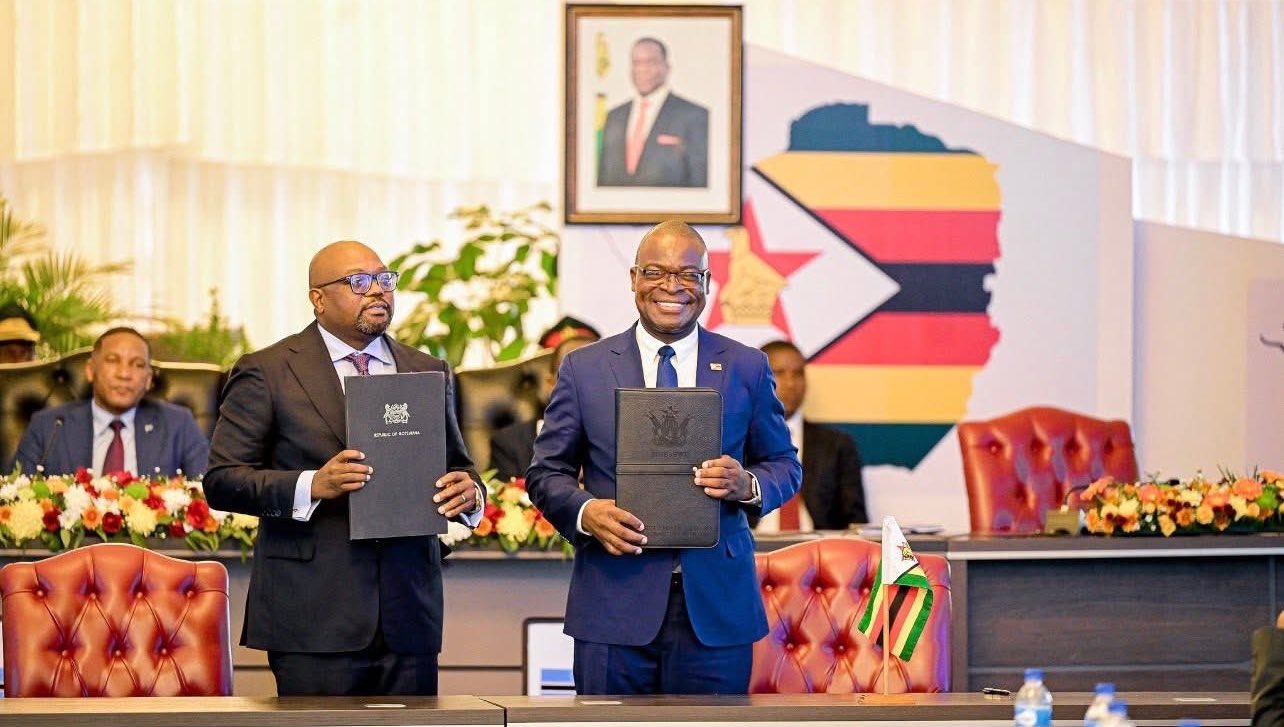
Harare became the stage for renewed Southern African solidarity this week as the 5th Session of the Botswana-Zimbabwe Bi-National Commission concluded, co-chaired by President Advocate Duma Gideon Boko and Zimbabwean President Emmerson Dambudzo Mnangagwa.
The session ended with the signing of ten bilateral agreements and a Memorandum of Understanding across defence, trade, justice, aviation, and heritage, marking a decisive step towards deeper integration between the two nations.
Sharing opening remarks as Co-Chair, President Boko expressed appreciation for Zimbabwe’s hospitality and reaffirmed the strong historical, legal, and economic ties between Botswana and Zimbabwe, rooted in shared bilateral relations and long-standing cooperation.
He emphasised that the Bi-National Commission is a key platform for advancing practical collaboration, reviewing progress, and identifying new areas of mutual benefit.
The President of Botswana called for greater economic complementarity between the two countries to promote shared growth rather than competition, highlighting priority sectors such as health, agriculture, trade and investment, infrastructure, energy, tourism, defence, and regional security.
President Boko also raised concern over the growing threat of synthetic drugs, urging stronger cross-border cooperation, policy harmonisation, and coordinated security responses.
Turning to the continent’s broader outlook, he underscored Africa’s strategic strength, noting its vast natural resources and youthful population, and called for greater unity and confidence in shaping global outcomes.
“We are here in Zimbabwe to script a future where African nations speak with one voice, act with confidence, and compete on the global stage from a position of strength,” he said. (Source: Live on Facebook, President Duma Boko)
“A future where our young people are not forced to look outward for opportunity, but find it within our own economies. This is our new Chimurenga, rooted in unity, driven by progress, and defined by the determination to build an Africa that works for its people.”
The commission focused squarely on implementation, with both leaders stressing the need to align priorities, resolve bottlenecks, and accelerate joint projects that deliver tangible outcomes.
Presidents Mnangagwa and Boko witnessed the signing of the agreed minutes of the 5th session alongside nine sector-specific accords: Defence Cooperation and Training Exchange Programmes; Police Cooperation in Combating Livestock Theft and Other Cross-Border Crimes; Immigration Cooperation; Cooperation in Prisons and Correctional Services; Transfer of Sentenced Persons; Coordination of Aeronautical Search and Rescue Services; Cooperation in Civil Aircraft Accident and Serious Incident Investigation; Promotion of Cooperatives, Micro, Small and Medium Enterprises; and Economic Trade and Investment Promotion.
The tenth instrument, an MOU on collaboration in the Museum of African Liberation, reinforces a shared commitment to heritage alongside economic and security cooperation. Together, the agreements strengthen legal frameworks, improve mobility and safety, and open new channels for business between Gaborone and Harare.
President Boko concluded by stressing the importance of turning dialogue into tangible results that improve livelihoods, reaffirming that Botswana and Zimbabwe are rising together toward shared prosperity and sustainable development. With the ink now dry, the mandate is clear: move from dialogue to delivery, and ensure the next Chimurenga is measured in jobs, trade, and unity.