“The door is not just open for me, but everyone who’s writing in Southern Africa. Our stories and our voices matter.” ~ Sue Nyathi
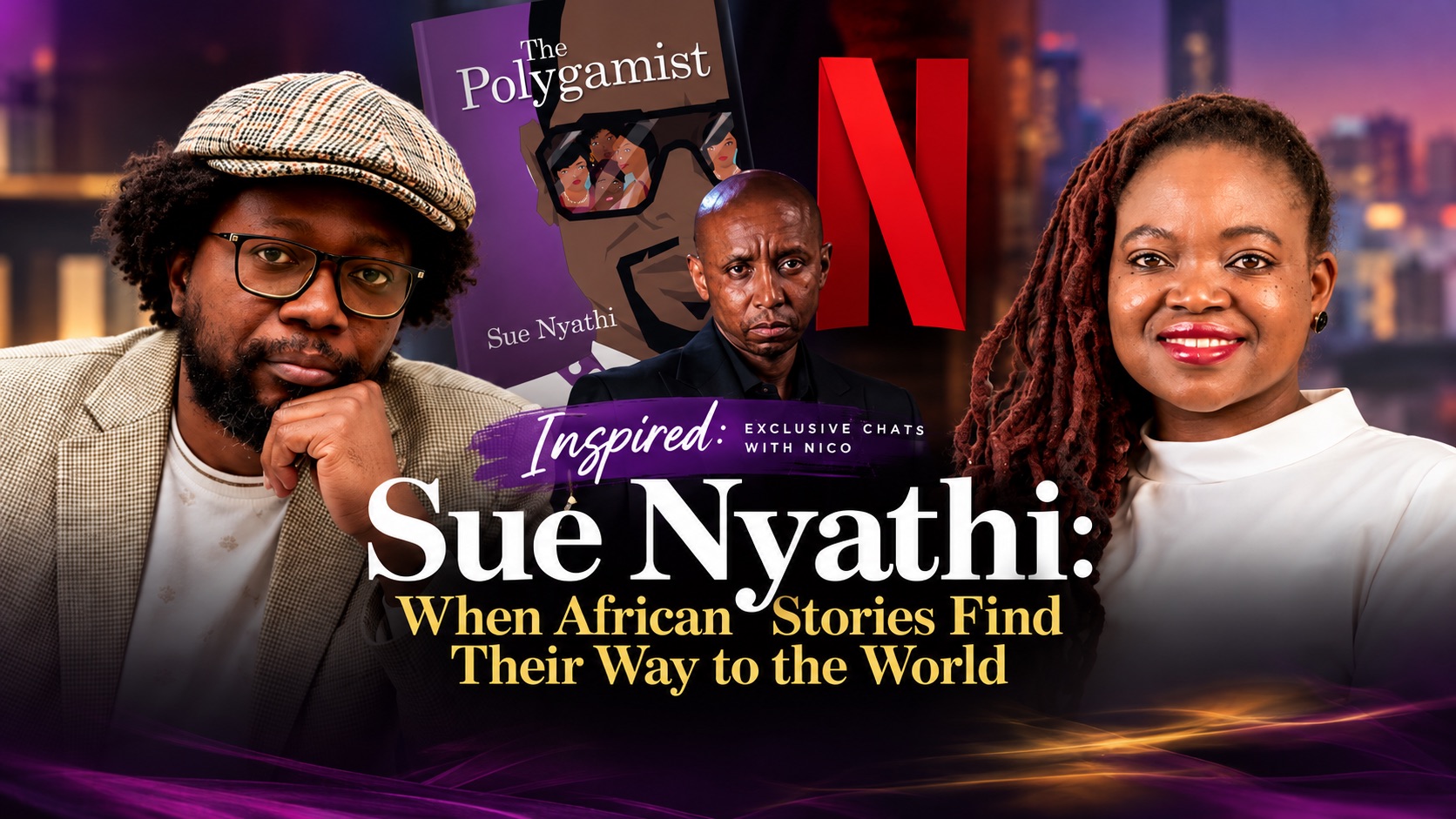
By Nico Abote: There is something particularly beautiful about watching a story travel.
A story can begin quietly, sitting between the pages of a book, perhaps known only to a relatively small community of readers. Then, years later, those same characters suddenly walk off the page, find faces and voices, and enter living rooms thousands of kilometres away.
For Zimbabwean author Sukoluhle “Sue” Nyathi, that journey has taken more than a decade.
Her debut novel, The Polygamist, was published in 2012. Fourteen years later, the story found another life on screen through its Netflix adaptation, re-introducing Sue, her characters and, importantly, a distinctly Southern African story to a much wider global audience.
During our chat with Sue for this edition of Inspired: Exclusive Chats with Nico, I jokingly suggested that perhaps she should now simply be introduced as the creator of Jonasi.
She laughed.
“People are calling me Jonasi’s mom now. Mother of Jonasi. That’s what I’m known as.”
Perhaps there are worse problems for a writer to have.
Watching The Polygamist through my own lens as a filmmaker, one of the things that immediately struck me was the casting. There is always a risk when characters that have lived in readers’ imaginations for years are suddenly given physical form.
Here, however, the performances breathe life into the world Sue created. What surprised me more was discovering that Sue herself had never really imagined her debut novel reaching this point.
“This part has come as a surprise,” she told me. “This is the plot twist.”
And what an interesting plot twist it has become.
The story explores love, marriage, infidelity, tradition, generational differences and the increasingly complicated nature of modern relationships. But its origins are deeply personal.
Sue was born and raised in Bulawayo before later moving to Harare for work. Growing up, polygamy was not an abstract concept to her. Her maternal grandfather was a polygamist.
“He had five wives,” she explained.
For Sue, traditional polygamy therefore had a structure she understood. Her grandfather’s wives were not hidden from one another. They lived together on a farm, and her grandmother was the first wife, the matriarch.
Sue remembers asking her grandmother how she had coped with that arrangement. Her grandmother’s response was wonderfully practical:
“There were more hands to do the work.” Sue laughs when recalling it, because “work” can be interpreted rather broadly, physical work, emotional labour, raising families and everything else that comes with building a household.
But when Sue moved from the relatively conservative environment of Bulawayo to Harare, she began observing something different. It looked like polygamy, but it wasn’t quite the version she had grown up understanding.
“What I was seeing was a perverted kind of polygamy,” Sue said.
Men publicly presented themselves as monogamous while maintaining other relationships and, in some cases, entire families elsewhere. Sue describes it as a modern, underground form of polygamy. It is secretive. It operates through deception. And sometimes, she argues, the language of polygamy becomes a convenient way of sanitising what is essentially infidelity.
Traditional polygamy, as she understood it, required openness. A husband could tell his wife he intended to marry another woman. In some arrangements, the first wife could even participate in identifying someone she believed would fit into the family structure.
The modern version Sue was observing was something entirely different.
“You have these satellite wives leading parallel lives, but this man is the centre of it all because he’s the one who connects all these dots.”
Children are born into these separate worlds. Families exist alongside one another. Sometimes they know of each other; sometimes they don’t.
That contradiction fascinated her. And from there, The Polygamist began to take shape.
One of the most fascinating experiences for any writer must surely be watching somebody else interpret characters you created. Film is collaborative by nature. A writer creates the foundation, but once that story moves to screen, actors, directors, cinematographers, designers, editors and countless others begin adding layers of their own.
I asked Sue whether the actors captured the characters she had imagined. Her answer was emphatic.
“The acting was excellent.”
Jonasi, particularly, felt immediately familiar.
“His character felt like he woke up from the page and walked onto the screen.”
Other characters were interpreted somewhat differently from how she had originally conceived them, but Sue believes those changes still worked within the adaptation.
More importantly, she felt the ensemble delivered.
“You had two strong lead characters, and the whole cast… everyone came to the party.”
I couldn’t agree more. As filmmakers, we understand that a brilliant story alone doesn’t guarantee a brilliant film. Get the casting wrong and even great writing can struggle. Get the combination right, story, cast, crew and creative execution and something special can happen.
With The Polygamist, that combination clearly connected with audiences well beyond Zimbabwe. And that leads to perhaps the bigger story here.
For decades, Africans became accustomed to consuming stories flowing in one direction. Hollywood travelled to us. European stories travelled to us. American television, movies and cultural references crossed borders effortlessly and became part of our everyday conversations.
The opposite journey has historically been far more difficult. Sue calls attention particularly to writers from what she describes as Africa’s “deep south.”
“Writers from Southern Africa tend to be ignored,” she said.
Unless an African writer is published internationally or gains recognition through Western institutions, locally published work can struggle to travel beyond its immediate market.
“It’s easier for the West to sell their stories downwards. Their stories travel down to us. But for us to get our stories travelling upwards to the rest of the world, it rarely happens.”
That is why this moment matters beyond Sue Nyathi, its international response to The Polygamist is not simply a personal victory. It is proof of possibility.
Before the screen adaptation exploded into international conversations, Sue admits that many people outside literary circles had never heard of her. That changed remarkably quickly. But perhaps the most important thing she said during our conversation came immediately afterwards.
“Now it’s not just going to be about me. They’re going to come and look at what else is there. What else have we overlooked?”
That sentence stayed with me. Because perhaps that is exactly what African creatives need these breakthrough moments to achieve. Not simply open a door for one person, but force the industry to look behind that person and discover an entire room full of storytellers who have been there all along.
So, what comes after The Polygamist?
Naturally, I had to ask the question.
Sue has written beyond The Polygamist, including The Gold Diggers and A Family Affair, and her work continues to explore different aspects of African society.
So, if she could choose the next adaptation?
Her answer came fairly quickly.
A Family Affair.
Having watched audiences respond so strongly to the complicated family dynamics in The Polygamist, she believes A Family Affair contains equally rich territory for screen.
“There is an appetite for those kinds of stories,” she said.
And she describes it as an even bigger story, one where filmmakers could really “go to town.”
But family drama is far from the only world Sue wants to explore. The Gold Diggers, for example, examines migration and the experiences of undocumented migrants entering South Africa, an issue that remains painfully relevant within contemporary Southern African politics and society.
Her historical fiction also looks at Zimbabwe’s history alongside questions of personal identity. Families may sit at the centre of much of her storytelling, but around them Sue is documenting something much bigger: society.
One description Sue used during our conversation particularly interested me. She sees herself, in some respects, as a social anthropologist.
Her books are not simply intended to entertain. She wants them to leave a record of what society was wrestling with at a particular moment.
“If someone had to look at my books 40 years later, they’d understand what our society was grappling with.”
That thought gives The Polygamist an interesting second life. The novel was published in 2012. We are now in 2026, and many of the conversations contained within it , be it marriage, infidelity, power, gender, family structures and relationships, remain strongly unresolved. Sue finds that both interesting and frightening.
“Very little has changed.”
Before ending our conversation, I wanted Sue to speak directly to the young writer who may be sitting somewhere with an unfinished manuscript. Maybe they’re stuck on page one. Maybe page two. Maybe they’ve actually finished the book and nobody wants to publish it.
Sue understands rejection.
When she left Zimbabwe, she remembers the local publishing industry as having virtually collapsed. Moving to South Africa didn’t magically make things easier. Rejections followed.
Her answer to surviving that journey is deceptively simple: Persistence.
“You have to persist. Even if doors are closed, you have to be persistent. You have to be passionate about it.”
Writing, she reminds us, is rarely glamorous. Many writers cannot sustain themselves entirely through royalties. The financial rewards may take years to arrive, if they arrive at all.
So something else has to keep you at the desk.
“You have to love writing because that’s what fuels you to finish a book. It’s what fuels you to keep going.”
Sue spent more than 15 years working in financial services and describes herself as an investment analyst by profession and a writer by passion. Eventually, she made the difficult decision to leave corporate life and pursue writing full-time.
It wasn’t a decision everyone understood. Including her father.
She shared a particularly touching moment with me toward the end of our conversation. Her father recently admitted that he had been disappointed when she left her established career. He simply couldn’t understand why someone would walk away from that security to pursue writing.
Years later, watching what has happened with her work, he finally told her:
“This is wonderful. I’m proud of you.”
Sue told me she had never heard him say those words to her before. Sometimes people will not understand the road you’re walking because they cannot yet see where it leads.
As our conversation ended, we returned to something that has become increasingly important to me in my own journey through television and film: Africans owning, developing and telling African stories.
The Polygamist has sparked debate. Some viewers are uncomfortable. Others are fascinated. Some have gone searching for the original book after discovering the screen adaptation.
And that last part excites Sue. The screen has, in some ways, sent audiences back to the page. It has “ignited a desire to read again,” she said.
That is something worth celebrating. We don’t have to agree with everything our stories show us. Sometimes their job is precisely the opposite. Sometimes stories need to disturb us enough to start conversations we have spent years avoiding.
As Sue put it when we discussed some of the controversy surrounding the adaptation:
“These are realities… We can’t hide away from these issues.”
And maybe that is where the power of African storytelling lies. Not in creating stories designed to explain Africa to the world. Not in sanitising ourselves until our experiences become universally comfortable.
But in telling our stories truthfully, in our voices, from our communities, through characters who carry all the beauty, humour, contradiction and messiness of who we really are.
Sue Nyathi wrote one such story fourteen years ago. Today, the world is talking about it. And somewhere in Bulawayo, Harare, Johannesburg, Lusaka, Gaborone or another corner of our continent, another writer may be sitting with a manuscript that the world doesn’t yet know it needs.
Keep writing. The plot twist might simply be waiting.
About Sue Nyathi
Sukoluhle “Sue” Nyathi was born, raised and educated in Bulawayo, Zimbabwe, and currently lives in South Africa. An investment analyst by profession and writer by passion, she spent more than 15 years in the financial services sector before leaving corporate life in 2018 to pursue writing full-time.
Her published works include The Polygamist (2012), The Gold Diggers (2018) and A Family Affair (2020). She also edited When Secrets Become Stories: Women Speak Out (2021), an anthology of nonfiction essays exploring gender-based violence.
Inspired: Exclusive Chats with Nico is a conversation series by filmmaker, television director and media strategist Nico Abote, exploring the journeys, ideas and defining moments of African creatives, storytellers and changemakers.