Lesotho’s Polihali Dam Project Reshapes Regional Water and Energy Futures

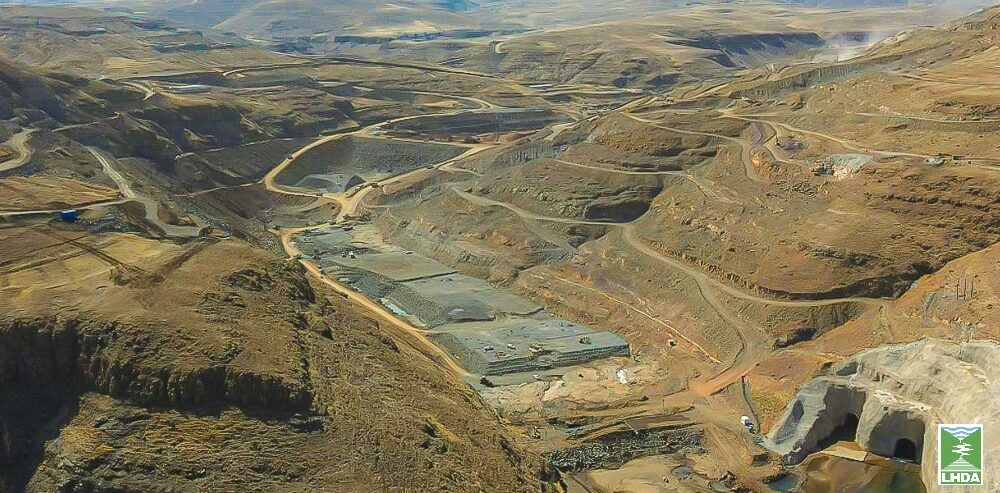
Construction of the Polihali Dam in Lesotho’s highlands is progressing after years of delay, according to the Lesotho Highlands Development Authority (LHDA). Approximately 30 per cent of the main works have been completed, with expenditure reaching M18 billion (R18 billion) of the total M53 billion budget by the end of July 2025. The project, located at the confluence of the Senqu and Khubelu rivers in Mokhotlong, forms a central component of Phase II of the Lesotho Highlands Water Project (LHWP).
Once completed, the dam will generate a reservoir covering more than 5,000 hectares with a storage capacity of 2,325 million cubic metres. This will increase annual water transfers to South Africa’s Gauteng province from 780 to 1,270 million cubic metres and enhance output at Lesotho’s ‘Muela hydropower plant from 500 GWh to 800 GWh per year. Such outcomes underscore the interdependence of water and energy security between Lesotho and South Africa, placing the project at the centre of wider debates about resource-sharing and sovereignty across Southern Africa.
The development, however, is not without complexity. The LHDA reports that more than 7,200 community assets have been expropriated, with M154 million paid in compensation for nearly 5,600 of these. Compensation processes have been slowed by disputes over ownership, missing documentation, and the absence of banking facilities for some claimants, many of whom have migrated to South Africa for work. While the project has generated employment for about 14,000 individuals, its overall impact on Lesotho’s 30 per cent unemployment rate remains limited.
Environmental management has also presented challenges. According to Matla a Metsi Joint Venture, which supervises the dam works, contractors have generated over 20,500 litres of waste oil, nearly 9,000 kilograms of hazardous waste, and more than 34,000 cubic metres of wastewater. Roughly 49 tonnes of general waste have been directed to landfill. Although 40 environmental incidents have been reported, none were classified as significant. Nevertheless, communities continue to voice concerns over dust, noise, air pollution, and water quality, highlighting the delicate balance between infrastructure development and ecological resilience.
Delays have remained a recurring issue. Initial excavation, tunnelling, and spillway works progressed slower than anticipated, with only 44 of the planned 87 interior plinth blocks completed by late August 2025. Grouting of external plinths has yet to commence. As a result, water impoundment, originally scheduled for January 2025, has been rescheduled to November 2026, with overall project completion now forecast for between August and September 2029.
Complementing the dam is a network of new transport infrastructure. Three major bridges — the Senqu, Khubelu, and Mabunyaneng — are being constructed to replace crossings that will be submerged once the reservoir fills. The Senqu Bridge, the most complex of the three, spans 825 metres and rises 90 metres above the riverbed. Costing M2.3 billion, it is designed to withstand floods and earthquakes, with a projected lifespan exceeding a century. Initially due for completion in November 2025, it is now expected in February 2026. The Khubelu and Mabunyaneng bridges are two-thirds complete.
A 38-kilometre transfer tunnel linking Polihali to the existing Katse Dam will enable expanded water transfers to South Africa. Two tunnel boring machines imported from China will each excavate 17.2 kilometres from opposite ends. Boring is scheduled to begin from the Katse side in early 2026, with the Polihali side following later that year.
The Polihali Dam project exemplifies the interconnected challenges and opportunities of transboundary resource management in Africa. For Lesotho, it promises increased energy generation and economic activity. For South Africa, it provides a vital contribution to water security in Gauteng, the country’s economic hub. Yet the project also raises questions of equity, environmental sustainability, and long-term benefit distribution, not only between the two states but within Lesotho itself.