A Quiet Shift Creatives Can’t Ignore: What ZIMRA’s Voluntary Disclosure Means for Us

From one artist to another…
If you’ve been creating, performing, collaborating, teaching, uploading, invoicing, or simply getting paid in bits and pieces, you’ve probably felt it: the creative economy in Zimbabwe has grown faster than the systems around it. Now, those systems are catching up.
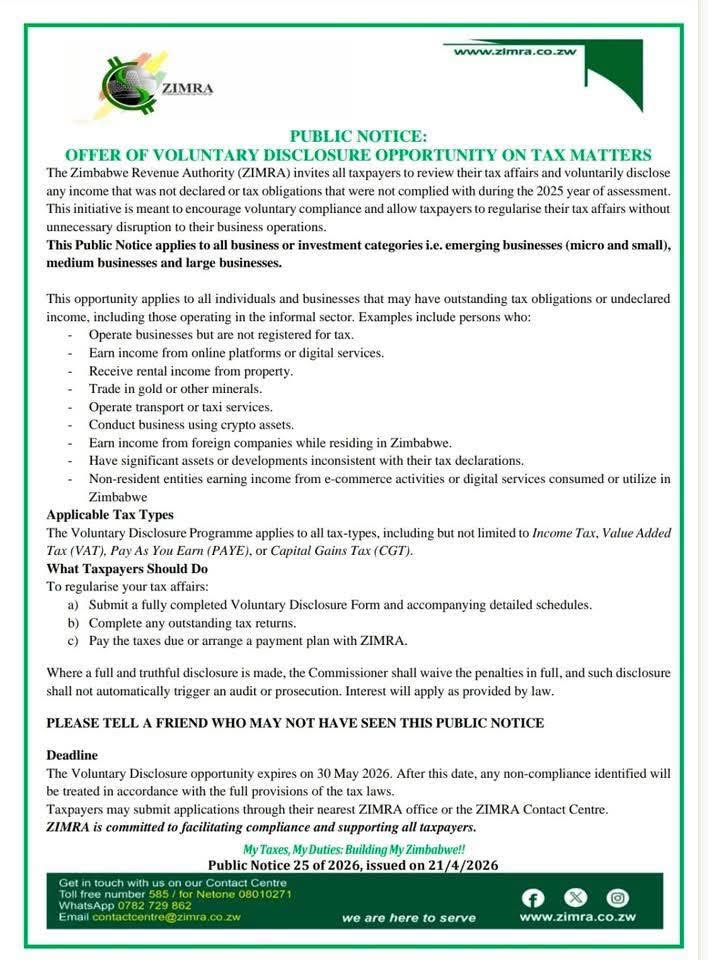
The recent public notice by the Zimbabwe Revenue Authority (ZIMRA) introducing a Voluntary Disclosure Programme (VDP) is more than just another tax announcement. It signals a shift in how income, especially creative, informal, and digital income, is being viewed. And for creatives, it’s something worth understanding early.
At its core, the VDP is an invitation. ZIMRA is asking individuals and businesses to come forward and declare income that may not have been previously disclosed, particularly for the 2025 tax year. The key incentive is that penalties will be waived for those who make a full and honest disclosure within the given window. That alone makes this moment significant. It creates space to correct past gaps without the usual financial consequences that often discourage people from engaging with the tax system at all.
What stands out is who this programme is really aimed at. The examples listed, people earning from online platforms, informal businesses, cross-border work, digital services, clearly point to the modern way creatives earn. That’s us! Musicians, designers, content creators, facilitators, and performers often operate across multiple income streams that don’t always fit neatly into traditional employment structures. For a long time, this made it easy to exist in a grey area. But that grey area is shrinking.
For many creatives, the concern won’t necessarily be about wrongdoing, but about uncertainty. Not everyone has deliberately avoided compliance; many simply started informally, learned on the go, or didn’t fully understand what was required. This programme acknowledges that reality. It lowers the barrier to entry by removing the fear of penalties and creating a pathway to regularise one’s affairs.
Still, this is not just about fixing the past. It is also about positioning for the future. As the creative industry continues to grow, so do the expectations around professionalism and accountability. Increasingly, opportunities, whether corporate partnerships, grants, international collaborations, or large-scale bookings, require a level of formal structure. Being tax compliant is no longer just an administrative task; it is part of building credibility.
For creatives, this moment calls for a simple but honest assessment. What income streams exist? Which ones have been declared, and which ones have not? Are there missing returns? Are finances clearly separated between personal use and business activity? These are not always comfortable questions, but they are necessary ones. The answers will determine whether it makes sense to take advantage of the VDP window.
Getting compliant does not have to be overwhelming. It can begin with small, practical steps. Start by identifying and documenting all sources of income, no matter how irregular they may seem. Create a clear separation between personal finances and creative business activity, even if it is just through basic record-keeping. Register with the relevant authorities if that hasn’t been done yet, and begin to understand which tax obligations apply. Where there are gaps, use the current window to disclose and correct them.
More importantly, build consistency going forward. Tracking income, keeping simple records, and filing returns regularly can prevent the kind of backlog that makes compliance feel intimidating in the first place. It is less about perfection and more about discipline.
There is also a deeper shift required, one of mindset. Many creatives still see themselves as “just artists” or “just trying things out.” But the moment money begins to flow from creative work, it becomes economic activity. And economic activity comes with structure. Embracing that structure does not diminish creativity; it sustains it.
This development ultimately reflects a maturing ecosystem. For years, creatives have pushed to be recognized as serious contributors to the economy. That recognition comes with both opportunity and responsibility. The VDP is one sign that the sector is being taken seriously enough to be brought more fully into the formal system.
So rather than viewing this purely as pressure, it may be more useful to see it as an opening. A chance to clean up, to organize, and to build a stronger foundation for whatever comes next. The work creatives are doing has value. Ensuring that it is properly structured and compliant is one way of protecting that value over the long term.